
The Government has laid out its ambition for an 80% employment rate – something L&W has called for since 2022. The economic, social and individual benefits are clear: our previous research shows reaching this target would boost our economy by £23 billion, improve the public finances by £8 billion and raise household incomes by £830 per year.
We know that large and persistent inequalities between groups are holding back the overall employment rate. Disabled people are much less likely to be employed with just half of disabled people in work, compared to more than four in five non-disabled people. Closing the disability employment rate gap would mean an extra 2.4 million people in work.
New L&W research highlights the need for a fundamental system change to reverse these trends. The current system is not set up to support disabled people and people with long-term health conditions, with only one in ten out-of-work disabled people getting help to find work each year, and the support they do get less likely to be successful.
Our report, commissioned by Health Equals, found that ableist bias and discrimination pervade the employment system (both entry into and in work) – and act as the biggest barrier to sustainable employment faced by disabled people and people with long-term health conditions. This manifests in a system focused on what people can’t do rather than what they can, with people being offered low-skilled, low-paid jobs despite being highly qualified and skilled, and feeling burdened by stereotypes. Far from supporting crucial ‘missing workers’ into key sectors of the economy, these experiences can have a profound negatively impact by knocking individuals’ confidence and resilience.
People we interviewed for this research shared their experiences, including being turned away from work because of a health condition, not wanting to discuss their disability on application forms in the hope it would improve their chances of securing employment, and not having the necessary adjustments or support in the workplace.
The root cause? A system not fit for purpose. The solution? Building a fully inclusive employment system.
Our report calls for an employment system underpinned by the principles of fairness and full inclusion, rather than one that is fundamentally ableist. The chart below sets out its key characteristics:
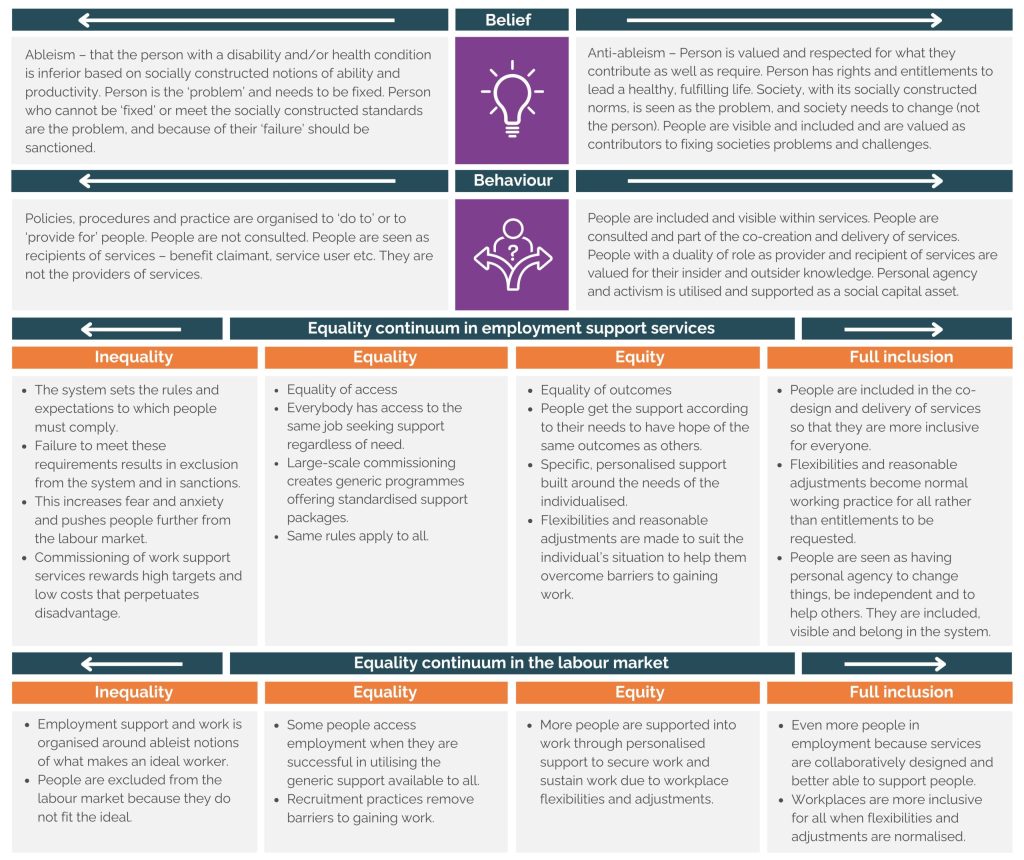
Building on these principles, the evidence shows that features of support that leads to positive outcomes for disabled people and people with long-term health conditions include:
- Joining up work, health and skills support so that support can be tailored
- Having specialist employment advisers with an in-depth understanding of people’s needs and preferences
- Lowering advisers’ caseloads so advisors have time to understand individual need
- Working with employers to provide individual adjustments
The Government aims to kick-start growth, build an inclusive and thriving labour market, and achieve an 80% employment rate. And it’s great to see a focus on supporting local areas to join up health, skills and work to improve outcomes.