As part of the VocTech Challenge: Skills for an economy in transition, Ufi VocTech Trust (Ufi) and Learning and Work Institute (L&W) are working with local stakeholders across the UK to identify the key local barriers to adult participation in learning and consider what actions we can take to address them. This blog sets out some of the themes arising from our discussions so far.
To find out more about our place-based collaborations, and the Green and White Papers that set out the background and commitments of the VocTech Challenge programme, please visit ufi.co.uk/challenge.
Place-based collaboration: Belfast
In November 2023, L&W and Ufi led an in-person workshop with key stakeholders in Belfast, to identify current challenges and opportunities for adult learning in the city.
Barriers to participation in learning
Stakeholders identified a range of barriers preventing adults in Belfast from participating in learning – with systemic barriers being a key factor limiting engagement. This includes the disjointed skills system in Northern Ireland, with responsibility for skills and employment sitting between two government departments, leaving individuals unsure of where to look for learning opportunities. Competition for funding between education providers was also described as leading to a lack of collaboration in the sector.
Other common barriers identified included poverty, poor access to digital equipment, a lack of funded childcare, and a reluctance to engage with formal education due to previous negative experiences. The latter was linked to the nature of the pre-16 education system in the region, which stakeholders described as outcomes rather than person-centred. Geography was also raised as a barrier, with people’s locations in Belfast influencing where they can work and study.
Our discussion also highlighted that for many people, there are multiple, intersecting barriers to participation in adult learning. Particular groups identified included young people with disabilities or physical or mental health conditions, and those with caring responsibilities.
Current provision is good, but there are gaps
Though it can be difficult for many adults in Belfast to participate in learning and education opportunities, stakeholders noted that good provision does exist in the city for those who are able to access it. Voluntary sector organisations who specialise in supporting young people with multiple barriers were mentioned as examples of good practice.
However, stakeholders noted that these organisations are often constrained by funding challenges, and that there are still many gaps in provision across the city. In particular, some learners do not have clear progression pathways and instead take multiple entry-level courses. Stakeholders also noted that matching provision to employer demand for specific skills can be a challenge, with employers often not knowing what provision would best meet their needs.
Opportunities to work together
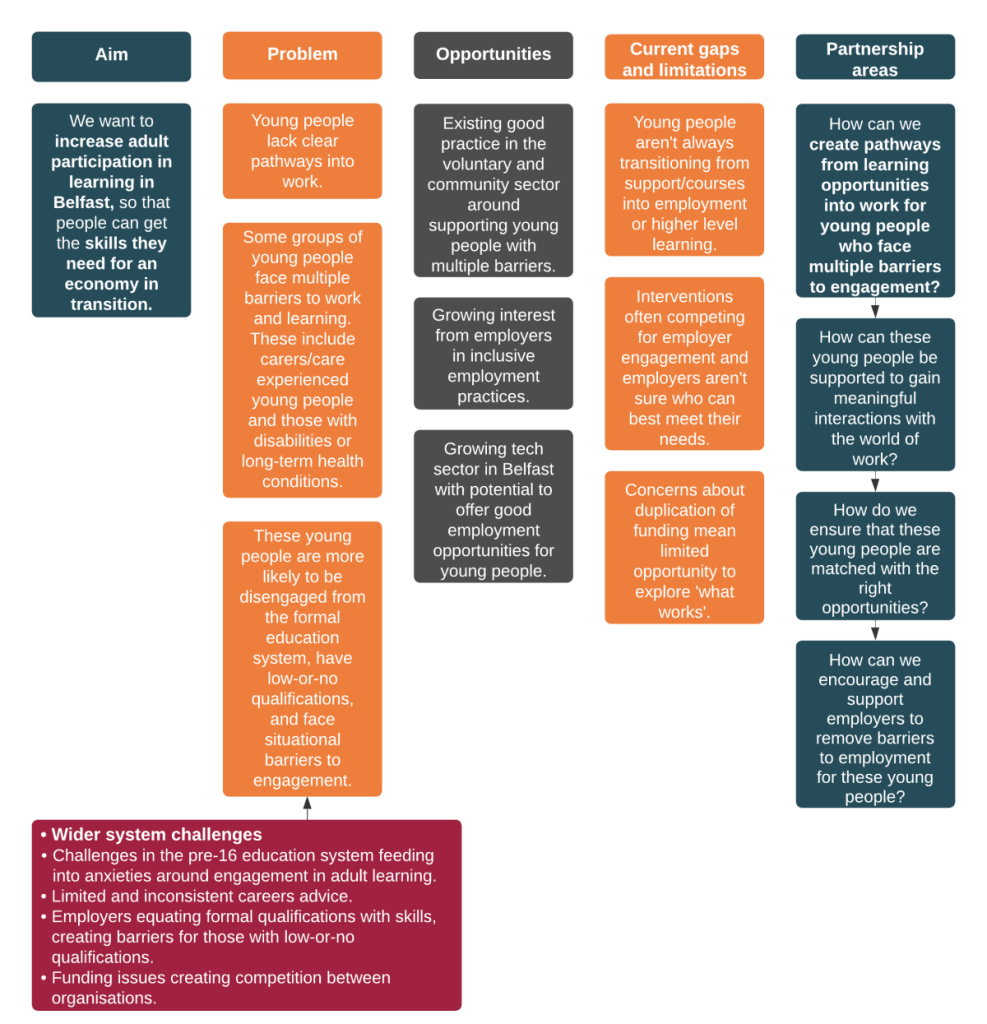
Based on the challenges highlighted in the discussion, stakeholders suggested that a place-based collaboration in Belfast could focus on:
- Pathways from learning into work – stakeholders were particularly interested in how pathways into employment could be made more accessible for young people with disabilities, long-term health conditions, or caring responsibilities.
- Helping employers navigate the skills system
- Matching people to the right provision
Over the next few months, Ufi and L&W will continue to work closely with stakeholders in Belfast. We welcome involvement from local organisations working in education, employment and skills and any feedback on our findings so far.