Ufi VocTech Trust (Ufi) and Learning and Work Institute (L&W) have joined forces to launch an innovative place-based partnership programme aimed at increasing adult participation in learning. Together, we’re identifying key barriers to learning in four areas across the UK and designing targeted solutions to overcome them. Working closely with local partners, we’ll implement and evaluate these initiatives, ensuring lasting impact for individual learners, employers and communities.
Why Hull?
Hull, a city with immense potential, faces significant challenges in adult education. It ranks 146th out of 150 local authorities in England for Level 3 attainment and 131st for Level 2. Many residents encounter multiple barriers to learning, including mental health concerns, financial constraints, limited access to learning opportunities, and language challenges for non-native English speakers. And this has an impact on the next generation: 26.4% of children in Hull live in absolute low-income families, while 30.7% live in relative low-income households. Accessible pathways into adult education and work have the potential to make a transformative difference.
Harnessing local strengths
Hull’s vibrant arts and culture scene has already demonstrated its power to inspire. The 2017 City of Culture programme sparked civic pride and a surge in volunteering. Building on this momentum, our Hull partnership will leverage the city’s rich volunteer network as a gateway to encourage learning and boost employability, particularly for those furthest from learning and work.
Find out more about our partnership with Ufi VocTech Trust
Find out moreA game-changing partnership
Hull College, known for its excellence in vocational education, is teaming up with HEY! Volunteering, a network of 2,500 volunteers dedicated to arts, culture, and heritage. Coupled with grant-funding and support from Ufi, the programme aims to revolutionise adult learning in Hull through a pioneering programme designed to reduce barriers, engage adult learners, increase confidence and participation and develop the skills required to gain or progress in work.
Over the next 18 months, the partnership will develop an initial suite of 40 micro-credentials designed to meet Hull’s specific learner needs. These courses will focus on improving employability while tackling key barriers to learning. This will be supported by a new digital platform ‘hub’ for learning and volunteering opportunities and the development and implementation of employability skills programmes. The goal? To engage more adults through volunteering, to complete more than 8,000 volunteer shifts at local arts and heritage sites and see more than 1,000 learners complete new micro-credentials—boosting community engagement, career prospects and local skills requirements.
Innovative learning, accessible to all
By embracing innovative technologies, the programme will provide open-access courses, removing traditional barriers to education and ensuring learners can demonstrate their achievements. Learners can expect engaging content that evolves over time, ensuring relevance and impact. Plans include immersive learning experiences—such as escape-room-style courses—to make education more dynamic and interactive.
AI-powered support for learners
For adults with English language needs, AI-driven tools will offer personalised support. Hull College has already developed an award-winning approach using AI to assist students in vocational courses, and now their proven approach will be developed further as part of this programme. With AI technology constantly evolving, this area of innovation will continue to be refined and adapted to meet learners’ needs.
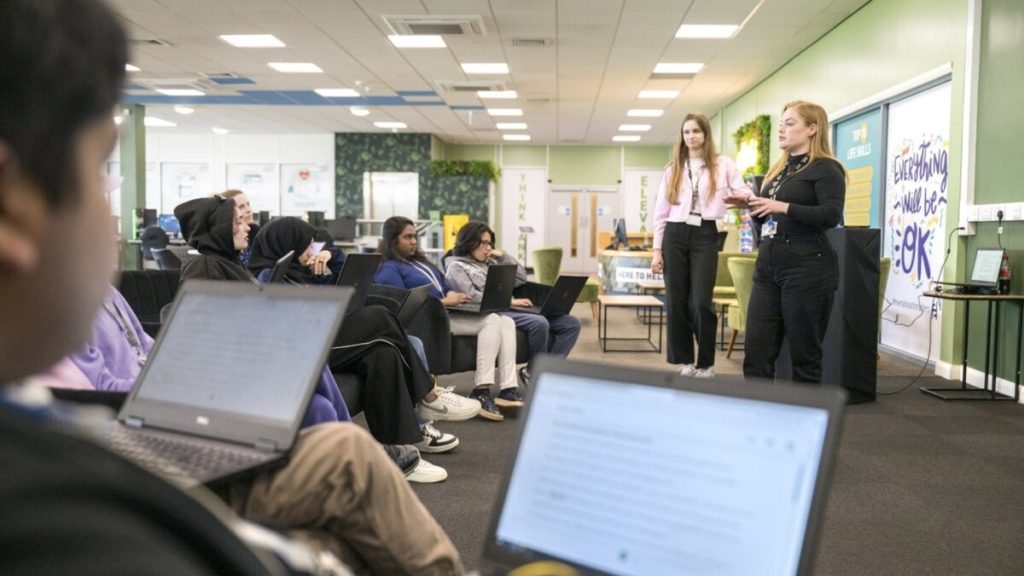
Students using Hull College’s AI Translate project to deliver live translation of course content to help students with low levels of English proficiency.
A model for the future
This programme is about more than delivering positive change in Hull—it’s about creating a scalable blueprint for communities across the UK. By championing the value of lifelong learning and dismantling barriers to education, this project aims to deliver insights and best practices that can drive change far beyond the city.
By evaluating impact and refining strategies, we’re paving the way for sustained improvement—ensuring that Hull’s success story can be replicated in cities facing similar challenges.
Hull is just the beginning. Similar projects are also underway in Aberdeen, Belfast and Newport. With collaboration, innovation, and determination, we are working to transform adult learning and unlock new opportunities for individuals and communities alike.